The film "Renewal" will likely appeal to just about everybody, because it addresses the way in which three major religions are incorporating environmental topics into their services. I could not find the whole video on the Internet. For clips, one can click here - http://video.google.com/videoplay?docid=8837700461738676590&ei=-6YQS_D0MYfCrQKjg9H0BA&q=renewal+sustainability&hl=en&view=2# or here http://www.youtube.com/watch?v=Rlsr32SqlOM.
I must admit that I was distracted by the sustainable meal that was being served during the film and did not catch much of what was said by the Muslims or Christians, but I was attentive to what was being done at the Teva Learning Center, which is a program that teaches Jewish children about sustainability. My mother is Jewish, and of any of the religions discussed, it is the one I would most likely want to practice.
Regarding the Jewish children, it was funny to me to see them at this camp for the environment. It almost made me wish I had been a part of something like that. I also thought it was funny because I used to go to a summer camp with a theme of Judaism, and it reminded me of that a little bit. Essentially, the counselors at Teva were trying to show the children their connection to nature and God. Thus they took them into forested areas and had them think critically and showed them awe-inspiring naturally sites, such as the cliff-scene from the first video clip I linked to above. Another practice that they incorporated was the "pishtolet," which was the collection of food waste after a meal and weighing it. I am not sure if that's how you spell the word, I checked here http://tevalearningcenter.org/ , which is the actual website of Teva, but to no avail. The goal of this activity, however, was to have as little waste as possible and make the students aware of how much food they take and throw away.
After watching the film, the class also discussed the eating restrictions of Muslims and Jews, or Halal and Kosher, respectively. Kosher eating has always fascinated me, similar to Halal, Kosher laws involve killing animals in a way that is not harmful to them, and facing them in a sacred direction during the process. A holy man blesses the animal. Kosher also can apply to other foods beside meat, in which case I believe it involves blessing of the food and preparing it without additives and with a process that prevents any kind of contamination.
I am not a religious person, but I am glad that religions are becoming involved in protecting the environment and promoting sustainability. This at least will spread the message through an important medium. I am also fascinated by Judaism and am glad that it is incorporating these messages, and I see how nature is very relevant to Jewish practices.
Friday, November 27, 2009

Downtown Ft. Myers and the SW Florida Historical Museum
I have lived in Southwest Florida all of my life, but there was still much for me to learn as it turned out. I have been to the SW Florida Historical Museum before, but I forgot much of what it contained. That is where the trip began and the following photo shows the first historical attraction that the class was treated to. What is so special about this house, you ask? Well, it carries the quaintly bigoted and anachronistic appellation of "cracker house." It is an actual house of a "Florida cracker" from at least a century ago. It essentially holds a combination bedroom and kitchen.
 Traveling through time once again, we arrived thousands, if not millions of years later with the artwork of the indigenous Native Americans of this region. I believe that the Miccosukee and Seminole were among the tribes of Southwest Florida. Here are some of their tools and decorative pieces (including the small "Marco Island Cat," which is a figurine right below the mask in the top center):

There were other exhibits, including fisherman artifacts and the photographic works of Clyde Butcher and his wife, but what interested me more than those came at the end of the tour. Unbeknownst to me, the small Page Field Private Airport in Ft. Myers once was the training grounds for air force troops around the time of World War II. Pictured first is a plane engine, and secondly is a mounted chain gun.

 We left the museum and were now loose in Downtown Ft. Myers. We saw parks that showcased various palm tree species from around the world, which I had no idea even existed.
 Going around the city hall building, one comes upon this massive mosaic billboard. It is called "An Alternative History" and essentially represents slavery and the mistreatment of indigenous peoples in this area times past. It's an amazing piece of artwork.
 The photo above was one of two cylinders that I had never noticed before. The two together are called "The Caloosahatchee Manuscipts." A little more information about them can be found here http://www.waymarking.com/waymarks/WM5DNP_The_Caloosahatchee_Manuscripts_Ft_Myers_FL.
 Above is a lovely view of the Caloosahatchee River from the downtown dock area.
And our last stop was at the commemorative fountain (pictured below) in Downtown Ft. Myers, which I believe is named "The Three Friends," which included Thomas Edison, Henry Ford, and Harvey Firestone. All of whom lived in Ft. Myers and on the Edison Home Estates. In light of this class, which deals with environmental issues, such as energy conservation and reducing carbon emissions, these three individuals actually could be called the root cause of our environmental problems today. Though regarded as great men, Thomas Edison inventing so many electrical gadgets, and Ford and Firestone assembling the first cars, their mechanical accomplishments would use up the earth's natural resources, cause desire for material objects, and in effect, destroy the environment!


After the "cracker house," the class was taken through an old train car, which ran through this area when the train line was still running. Pictured here is a small, yet elegant room in the car.

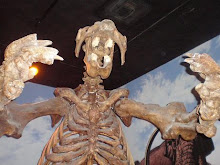
The house and the train car were relatively recent history however, and the museum guide took us next to see the remains of prehistoric creatures that once lived right here in Southwest Florida. This was very interesting to me! The size of the creatures that once inhabited the cities that I call home is mindboggling. Difficult to frame the beast in a single photograph, I was only able to capture the upper body of this giant...SLOTH! Am I reading the information card correctly, this twenty foot tall monster that looks like Bigfoot was a SLOTH!? Sufficed to say, that was the first time I had ever seen such an animal. Sloths in modern times are only 3 to 4 feet long, and I don't think they stand on their hind legs very often. There were also gigantic shark teeth and a large woolly mammoth head featured in this display.
 Traveling through time once again, we arrived thousands, if not millions of years later with the artwork of the indigenous Native Americans of this region. I believe that the Miccosukee and Seminole were among the tribes of Southwest Florida. Here are some of their tools and decorative pieces (including the small "Marco Island Cat," which is a figurine right below the mask in the top center):

There were other exhibits, including fisherman artifacts and the photographic works of Clyde Butcher and his wife, but what interested me more than those came at the end of the tour. Unbeknownst to me, the small Page Field Private Airport in Ft. Myers once was the training grounds for air force troops around the time of World War II. Pictured first is a plane engine, and secondly is a mounted chain gun.
We left the museum and were now loose in Downtown Ft. Myers. We saw parks that showcased various palm tree species from around the world, which I had no idea even existed. Going around the city hall building, one comes upon this massive mosaic billboard. It is called "An Alternative History" and essentially represents slavery and the mistreatment of indigenous peoples in this area times past. It's an amazing piece of artwork.
 The photo above was one of two cylinders that I had never noticed before. The two together are called "The Caloosahatchee Manuscipts." A little more information about them can be found here http://www.waymarking.com/waymarks/WM5DNP_The_Caloosahatchee_Manuscripts_Ft_Myers_FL.
 Above is a lovely view of the Caloosahatchee River from the downtown dock area.
And our last stop was at the commemorative fountain (pictured below) in Downtown Ft. Myers, which I believe is named "The Three Friends," which included Thomas Edison, Henry Ford, and Harvey Firestone. All of whom lived in Ft. Myers and on the Edison Home Estates. In light of this class, which deals with environmental issues, such as energy conservation and reducing carbon emissions, these three individuals actually could be called the root cause of our environmental problems today. Though regarded as great men, Thomas Edison inventing so many electrical gadgets, and Ford and Firestone assembling the first cars, their mechanical accomplishments would use up the earth's natural resources, cause desire for material objects, and in effect, destroy the environment!
Should we REALLY be honoring these men? My proposed title for this fountain is the "Three Horsemen of the Apocalypse."

Thursday, November 26, 2009
Affluenza - A Material World Indeed

Perhaps living simply, like the Tibetan lamas in the photo above is the cure for our material wants. Picture courtesy of http://news.xinhuanet.com/english/2009-03/11/xin_03203061108471561504517.jpg.
The following is a quiz that I took at this website - http://www.pbs.org/kcts/affluenza/diag/have.html - which gauges one's level of "affluenza," which is essentially the habit of spending often and loving material objects.
The Quiz:
1. I'm willing to pay more for a t-shirt if it has a cool corporate logo on it.
True
2. I believe that if I buy the cocktail dress, the cocktail party will come.
False, but that's because I am a man, and don't wear dresses, but usually I do wear whatever I already own to a party.
3. I have a shoe collection Imelda Marcos would envy.
False
4. When I'm cold, I take my clothes off and turn up the heat.
False, though in Florida it's the opposite.
5. I'm willing to work 40 years at a job I hate so I can buy lots of stuff.
False, I would rather work at my current job throwing luggage and making $10 an hour than do a job I don't like, however, I do want to make more money at a job I'll enjoy!
6. When I'm feeling blue, I like to go shopping and treat myself.
False
7. I want a sports utility vehicle, although I rarely drive in conditions that warrant one.
False, I never want an SUV!
8. I usually make just the minimum payment on my credit cards.
False
9. I believe that whoever dies with the most toys wins.
False
10. Most of the things my friends/family and I enjoy doing together are free.
True
11. I don't measure my self-worth (or that of others) by what I own.
True
12. I know how to pinch a dollar until it screams.
True
13. I worry about the effects of advertising on children.
True, honestly!
14. To get to work, I carpool, ride my bike or use public transportation.
False
15. I'd rather be shopping right now.
False!
How was it scored?
For questions 1-9 and 15, give yourself 2 points for true and 1 point for false.
For questions 10-14, give yourself 0 points for true and 2 points for false.
How did I do?
I scored 13!
What does the website have to say about that...
If you scored:
10-15 No dangerous signs of Affluenza at this time. Watch Affluenza to help build immunity.
16-22 Warning: You have mild Affluenza. Watch Affluenza to help prevent a full-blown case, and see our handy tips for squishing the Affluenza bug.
23-30 Cut up your credit cards and call a doctor! Memorize our list of bug-beating tips. Watch Affluenza, and then watch it again.
...So I did pretty well. I answered honestly and I really do conserve my money, reuse things when possible, and don't like to buy new things very often. I like to SAVE MONEY! In fact if anything, I would say that I save to a ridiculous degree, but I do put down a lot of money every once in a while for something I really want.
Here is a link to the "Affluenza" video that was watched in the course - http://video.google.com/videoplay?docid=6806939155215812613&ei=cE4PS66yAZ_oqQLO5ZHPCg&q=affluenza&hl=en. Watching it a second time, there were several things that caught my attention. For one, the film said that by 1987 there were more shopping malls than high schools in America. Also, it showed some really unethical marketing tactics being used to target children; including selling food at schools that kids are warned against in their health classes! "In ninety percent of divorce cases, arguments over money play a predominant role," the film also states. The documentary talks about how less money is saved in the United States today than in many other developed countries. I, however, save more than the 4%, which is our current level (though I recall from economics class that this number can change based on general economic conditions). These are all bad signs of the role of money in our society. It was mentioned in the film that Roosevelt foretold that unbridled capitalism would corrupt society. Some solutions they have for "affluenza" are the "buy nothing day," which was actually on 11/29 (I think I bought a bottled water from a vending machine though). The book Your Money or Your Life was recommended. Living in "co-families" - two families sharing a house - was also suggested, but that sounds like a stretch. I'm fine with roommates, but I guess I'd have to try the co-family situation in order to understand it.
Also there is this site which discusses this silly, yet serious disorder - http://www.pbs.org/kcts/affluenza/escape/action/crash.html. On this site, 10 methods for reducing spending habits are discussed. I agree with all of them for the most part. I have never read and probably will never read the book they suggest, but I have read other books on money management such as Jim Cramer's Stay Mad for Life, which I found very helpful and believe that everybody should read such a book. Considering that my dad's primary hobby is fine-tuning his big screen projector and 61" TV system, throwing out the TV seems like a problem for me! Though I almost always am doing something else while watching TV. As for not having children, I think this website is really being absurd. I mean, if you're stupid enough to take this web site's advice on that, then maybe you're too stupid to have children, but I for one think that is an insane suggestion, and I intend to have children someday. Although I do believe people probably should be financially secure when having children, and should not have too many kids.
One final comment, and this has been a topic of discussion since the first field trip, and in the "Affluenza" film, but I have recently fine-tuned it - living a simple life. I have lived quite simply, but not in the right way. I thought that in order to save money that I would have to buy some moderately junky food. I also had a gym membership for a while. Starting about a month ago, I changed all of that. I started doing body-weight exercises, which are essentially as good as weightlifting at a gym, and it's saving me $40 a month! I have also adopted different eating habits. I thought that fruit and other healthy foods were too expensive, and apparently others my age think similarly. However, I have found that I can still shop around and get nutritional, sustainable foods for as much as I was spending. I'm eating organic foods over the garbage I used to eat. And fruit used to be nonexistent in my diet, now I eat at least four a day! I feel completely different! Truly, tribal peoples with no material objects, who live off of the natural crops and animals of the land, live better than the average American! That is the cure for "affluenza"!
Tuesday, October 20, 2009
Big Environmental Problems Come In Small Packages
 Image taken from - http://cache3.asset-cache.net/xc/200020196-001.jpg?v=1&c=IWSAsset&k=2&d=B3B7071D257FC0393786A19E73AD796F65A938CC3E7C961545A15C5DB07C84C900123AA3B5A18ED0.
Doing a quick search on Google, I found this United Kingdom based website that talks about product packaging and the environment - http://www.wasteonline.org.uk/resources/InformationSheets/Packaging.htm. The site speaks of how paper and cardboard are the most heavily used packaging materials in terms of weight. Plastics are in wide use for the packaging of food products and "is the most energy efficient" and sturdy material for packaging. Aluminum, glass, and steel are also being used for certain items. They suggest reducing, reusing, and recycling in that order.
Some of the packaged, portable products I use almost on a daily are the following:
- My laptop computer. It came in a cardboard box with Styrofoam inserts, and also included additional booklets sealed in plastic. The mouse also came in a separate plastic package.
- The carrying case for the laptop came in a cardboard wrap. I use it every day to carry items to work and school. The computer, mouse, and carrying case all came to me in a cardboard shipping package.
- My cell phone was purchased from Best Buy and came in a cardboard box with plastic inserts and booklets sealed in plastic.
- One of the remote controllers I use for my television came in the cardboard box my TV set came in, and the other controller came in the DirectTV box's cardboard box.
- All of my textbooks for FGCU came sealed in plastic from the University. They were all used, except for my accounting textbook, which came separately sealed in plastic.
- Notebook paper that I use at school came in a plastic wrapping.
- Mail and packages that I receive comes in various envelopes and packaging. I get junk mail only occasionally.
- I usually eat protein bars when I am at work or school, and they come in a thin foil wrapping. I also eat trail mix that usually comes in a plastic pouch. On occasion, I will bring a small bowl of soup that comes in a tin/plastic can, with a plastic top. I sometimes also bring a tuna fish cracker kit to work. The total kit comes in a plastic/cardboard package, and the condiments and crackers are in plastic packets. The tuna fish is in a foil pouch.
- Some of the books I carry and read probably came in a plastic wrapping and were shipped to me in a cardboard box.
- Every now and again I will drink a soda from an aluminum can or a plastic bottle, and I drink from a bottled water almost every day.
- Paper towels could count as a portable item. I use them often and aside from being paper themselves, they come in plastic wrapping.
- I enjoy drinking tea, which comes in a bag to be dipped in water. The tea leaves come in some sort of sieved paper bag, and the bag itself comes in a paper wrapping. The paper-wrapped tea bags come in a cardboard, plastic wrapped box!
...Those are pretty much all of the portable, packaged items I can think of. Going to this website - http://www.pacinst.org/topics/water_and_sustainability/bottled_water/bottled_water_and_energy.html - one can read about how it takes 3 liters of water to produce one liter of bottled water, and in 2006 the bottling of water created 2.5 million tons of carbon dioxide! The 3 liters to produce 1 liter syndrome, reminds me of the same problem of which I spoke in my water blog, where cleaning and reusing a bottled water caused me to use 8 cups of water. In addition to these externalities, the bottles have to be shipped, or trucked, which uses further gas. Plastic seemed to be the main culprit in my packages, and though the British site mentioned at the beginning of this blog spoke of its efficiency, it still isn't that efficient or sustainable
The other major packaging material I saw was cardboard and paper, both of which require trees. Perhaps some of the materials are manufactured from recycled components, but I know there is still other energy and water being used in their production. Also not sustainable.
I would like to point out the fact that whenever I sell something online, which I do from time to time, I generally use a cardboard box from a past purchase and insert paper that is actually the wrapping for computer paper that my Dad uses at his print shop. I am proud of doing that, at least.
Feeling Lethargic Every Day Isn't My Only Energy Problem!
I'm just kidding, I don't feel completely lethargic every day, but enough to make the title of this blog funny, I would say. Anyway, energy, something I like to have. Who knew that using all of these electrical appliances was destroying the environment and costing tons of money? Maybe that's a naive rhetorical question, but here we go, a rundown of my electrical day, followed by my gas usage:
Note: I only accounted for electricity that was directly affecting me as trying to keep up with every usage of the electronics by my parents seemed impractical and impossible.
October 19, 3:00 PM: Checked the watt hours on the meter on the side of the house. Watt hours = 12,351
Also around 3:00 PM: I had my bedroom light, my fan, alarm clock, and TV on. As a result of the awareness gained instantly from this exercise, I unplugged my cell phone charger. However, I used my camera battery charger.
Shortly after 3:00: I used the rest room. I turned off the fan, light, and TV in my bedroom and turned on the light in the rest room. I noticed that there was a night light and air freshener that my mom had put in the bathroom, which are undoubtedly using electricity 24/7.
3:10: I turned off the bathroom light and turned on my room light, fan, TV, and computer.
3:25: Turned off computer.
3:50: Turned on computer.
4:15: I unplugged the camera battery charger.
5:10: I Turned off the computer.
6:00: I turned off everything in my bedroom and went running.
6:20: I came back from my run and took a shower, which required that I have the bathroom light on, and I used some hot water. Maybe I could shower in the dark, when the sun is out.
6:30: Used the microwave for 3o seconds to defrost bread for a sandwich I ate.
6:35: I turned on my computer, fan, light, and TV.
7:20: I turned off the fan, light, and TV in my room, but left my computer on. I went to the bathroom and turned on the light for 1 minute. I went out into the living room with my parents to eat dinner and watched our big screen TV for 20 minutes.
7:40: I went back into my room and put my light, fan, and TV back on.
8:50: I once again turned off the computer.
9:30: I turned the computer back on again.
10:15: I turned off the computer.
11:15: I used the rest room, and had the light on for about 5 minutes.
11:25: Big surprise...I turned on my computer.
12:40: I turned off the computer (it's true).
1:15: I plugged my cell phone charger in.
1:20: I turned on the bathroom light to brush my teeth.
1:25: Turned off bathroom light and I turned off the light in my bedroom so I could go to bed.
2:30: Turned on the light in the bathroom for 1 minute, then turned off the TV in my room.
October 20, 11:15 AM: I woke up, my fan and alarm clock were on all night. I went to the restroom, and turned on the light for 2 minutes. Then I turned off the fan in my room, because I thought it was cold in my room. I turned on the TV and light.
11:25: I turned off the light and TV in my room. I took a shower with hot water, and the bathroom light was on for approximately 10 minutes.
11:45: I went to Edison Community College to go tutor.
I did not return home until 5:30 PM and the meter now read:
12, 404 WATT HOURS!
No bueno. In addition to having my alarm clock on all day everyday, my home does have air conditioning, which seems to come on at least every hour. There were also those plug-ins in my bathroom. Oftentimes I forget to unplug my cell phone charger, but I have been trying to be better about that. I always have my fan on all night. Of course, sometimes I do laundry, and my parents use much electricity as well.
I learned that my electric company is the Lee County Electric Cooperative. Going to this link in the "About Us" section of their site - http://www.lcec.net/aboutus/images/Our%20Wholesale%20Energy%20Supplier.pdf - showed me that the electricity they serve is from the wholesale supplier Seminole. This site explains that their energy is powered by coal. Only a small fraction, 4%, is from alternative energy sources, however they are able to sell the waste to wallboard manufacturers.
Now for an evaluation of my gas energy usage:
A typical Wednesday at Florida Gulf Coast University involves driving there and back to my house, plus the occasional run to a gas station in between my classes, which is what I did on the Wednesday that I recorded my mileage. I had no passengers in my car, and usually do not. Only from doing the things I just mentioned resulted in me driving 53.2 MILES! A lot more miles than I expected.
My car, a 2004 Hyundai Sonata, has just a little over 84,000 miles on it right now, and it was purchased around this time in 2003, therefore, I drive approximately 14,000 miles a year. Which is a little less than I expected.
Looking at my car's energy score at http://www.fueleconomy.gov/, I found that my car emits 9.5 tons of carbon per year, when I plug in my annual miles data. It also had a 2 on a scale of ten of an air pollution score. It uses approximately 17.7 barrels of oil in a given year.
Dividing the 9.5 tons of carbon per year by 365 days gives me an average of 0.026 tons, which I believe translates into 52 pounds of carbon, if one assumes that the website was using the United States ton of 2000 lbs. That's practically a pound of carbon per gallon! If not more.
Final Thoughts
I think I did pretty poorly on electricity and gas usage. Not only does my household use a lot of electricity, but it is supplied by a coal power plant. I don't know what the other company, Florida Power and Light is offering, but I don't like it. Furthermore, I was very disappointed with my car's emissions. I thought that Hyundai's were supposed to have good fuel economy and be at least better than average on emissions and the like, but this was not the case.
I don't know what to do about these problems either, they're tough to curb greatly. I'm continuing to turn electric appliances off when not in use, but any major actions that could be taken will probably cost a fair amount of money up front. The same thing goes for my car. I've been very thankful for the fact that I finally paid off my car last month, and I didn't want to get a new car very soon, so that I could save up. So I may be keeping this carbon machine a little longer. Also, I know that living closer to FGCU and my job at the airport would be beneficial, but again cost comes into play. Assuming I spend $2000 on gas per year, living in an apartment instead of with my parents will cost me close to $6000, if I were able to only pay $500 a month. From the ecological footprint exercise in the related blog posting, living separately could possibly be less efficient environmentally as well.
Tough problems. And if I'm having these types of problems with my relatively simple lifestyle, the rest of the industrialized world is in big trouble!
Friday, October 16, 2009
Field Trip to Corkscrew Swamp - Well at Least Corkscrew Swamp Isn't Scr...In Danger of Being Destroyed!
Before venturing onto the boardwalk that takes one through the preserve, our student guide for the trip explained that the ratio of wildlife to people in Florida has progressively grown heavily in favor of people. But thanks to efforts like the Corkscrew Swamp, Florida is not entirely scr...in danger of being destroyed! In fact, Corkscrew Swamp is alive and well and beautiful, thanks to its founding organization, the Audubon Society.
I am glad and feel fortunate to have seen such a place. I enjoy bizarre, out of the ordinary occurrences in nature, and the Corkscrew Swamp falls near that category. It is a very mystical, lively place. The interiors of the swamp remind one of Yoda's planet of Dagobah in Star Wars. Perhaps not everyone will understand that reference, but suffice it to say that the canopy of prehistoric-looking trees, mosses, and unique creatures, gives one the feeling that "the force" is with them. However, that's a very pop-culture comparison. I could also compare it to the deep, dark regions that one would expect to find a Native American medicine man in the Amazon or the bayou of the southern United States. I would have expected to see such a place in the so-called "swamp" of Gainesville, Florida, but I had no idea that such places existed so close to where I live.

Speaking of Gainesville, here is a baby alligator that somebody walking the trail had found. It was explained that baby alligators carry the yellow bands, which are lost when they grow older.

Shortly down the trail to the boardwalk, my classmates and I came across this wildlife crossing sign, pictured right. It may seem insignificant, but it is actually a means by which animals can be saved.
A short distance from the sign was this large patch of sunflowers, an unexpected sight to see. The field of sunflowers was teeming with butterflies and locusts.


After passing through the Wizard of Oz, Poppy Field-esque land of sunflowers...it was time to get on the boardwalk. Pictured right was an initial scene that I came across. A good example of that mystical, "force" feeling. In this photo there are sturdy cypress with lichens growing on them - a sign of clean air. And there are many large air plants and flag grass plants. It is obvious that this is a slough area, with the tree-marked swamp.

Here at the left is a good example of a resurrection fern, which has become quite large on its host tree. Also it is a more-close up example of an air plant.

Ah, here above is a section of the Corkscrew Swamp with a flag grass marsh. I think I remember seeing flag grass some time ago when I went to the Six Mile Cypress Slough. It is apparently common to sloughs. It is a large, leafy plant. It seemed like birds liked this marsh area. Coming close to the end of our journey, I was able to capture this expansive view of the Swamp.

On the right is just a fraction of the mass of a gargantuan pre-historic looking tree. Trees such as these were not too uncommon on the walk. It is clearly very old and other trees are growing on it. I recall either the professor or guide saying that there used to be trees as large as sequoias in this region. I think this one ranks pretty closely to that size.
 It was also around the time of seeing the second alligator that my group and I heard the loud whoop of a Bard Owl, a very bizarre sound.
The Corkscrew Swamp was almost like a trip back in time a few thousand years ago. Again a very mysterious and powerful place. I think it was my favorite field trip yet. Seeing two alligators in one day was definitely cool. The only thing I wish I could have done there was to have tried a swamp apple, which was a fruit that I saw growing near the boardwalk. But all of them were out of reach. Supposedly it tastes somewhat of mango, and/or apple. A mystery yet to be solved.
I am glad and feel fortunate to have seen such a place. I enjoy bizarre, out of the ordinary occurrences in nature, and the Corkscrew Swamp falls near that category. It is a very mystical, lively place. The interiors of the swamp remind one of Yoda's planet of Dagobah in Star Wars. Perhaps not everyone will understand that reference, but suffice it to say that the canopy of prehistoric-looking trees, mosses, and unique creatures, gives one the feeling that "the force" is with them. However, that's a very pop-culture comparison. I could also compare it to the deep, dark regions that one would expect to find a Native American medicine man in the Amazon or the bayou of the southern United States. I would have expected to see such a place in the so-called "swamp" of Gainesville, Florida, but I had no idea that such places existed so close to where I live.

Speaking of Gainesville, here is a baby alligator that somebody walking the trail had found. It was explained that baby alligators carry the yellow bands, which are lost when they grow older.

Shortly down the trail to the boardwalk, my classmates and I came across this wildlife crossing sign, pictured right. It may seem insignificant, but it is actually a means by which animals can be saved.
A short distance from the sign was this large patch of sunflowers, an unexpected sight to see. The field of sunflowers was teeming with butterflies and locusts.

After passing through the Wizard of Oz, Poppy Field-esque land of sunflowers...it was time to get on the boardwalk. Pictured right was an initial scene that I came across. A good example of that mystical, "force" feeling. In this photo there are sturdy cypress with lichens growing on them - a sign of clean air. And there are many large air plants and flag grass plants. It is obvious that this is a slough area, with the tree-marked swamp.

Here at the left is a good example of a resurrection fern, which has become quite large on its host tree. Also it is a more-close up example of an air plant.

I don't know how anybody was able to spot this creature, but here is a snake nesting in a tree. You can tell that the "force" is strong with this one. I don't remember ever seeing a snake living in a tree before, very interesting.
http://www.flmnh.ufl.edu/herpetology/fl-guide/Storeriadekayi.htm - by looking here, it seems possible that it's a type of brown snake, but it's hard to say. Seems to have a thick body.

Here is another interesting animal living arrangement, a globe of spiderweb that was hanging out into the boardwalk.
Ah, here above is a section of the Corkscrew Swamp with a flag grass marsh. I think I remember seeing flag grass some time ago when I went to the Six Mile Cypress Slough. It is apparently common to sloughs. It is a large, leafy plant. It seemed like birds liked this marsh area. Coming close to the end of our journey, I was able to capture this expansive view of the Swamp.


On the right is just a fraction of the mass of a gargantuan pre-historic looking tree. Trees such as these were not too uncommon on the walk. It is clearly very old and other trees are growing on it. I recall either the professor or guide saying that there used to be trees as large as sequoias in this region. I think this one ranks pretty closely to that size.
Half of the class had been separated from my group during the trip, and we were tipped off that were was another alligator down the part of the trail we had not traversed. Here he is, sleeping on a log, not yet an adult.
It was also around the time of seeing the second alligator that my group and I heard the loud whoop of a Bard Owl, a very bizarre sound.The Corkscrew Swamp was almost like a trip back in time a few thousand years ago. Again a very mysterious and powerful place. I think it was my favorite field trip yet. Seeing two alligators in one day was definitely cool. The only thing I wish I could have done there was to have tried a swamp apple, which was a fruit that I saw growing near the boardwalk. But all of them were out of reach. Supposedly it tastes somewhat of mango, and/or apple. A mystery yet to be solved.
Wednesday, October 14, 2009
Field Trip to the Campus Trail - Forget UF, FGCU is the Swamp
That's right, I said it, I used to go to the University of Florida, but Florida Gulf Coast University is the REAL swamp. The university has its own watershed and aquifer. The guide for the trip told the class that the aquifer is actually used as a water source for buildings on campus.
 According to the website, and I think the professor also mentioned it, the melaleuca is an invasive species, non-native to southwest Florida.

Here is another example of a toasted palm, along with a beautiful orchid. Orchids were also a common occurrence on the trail.

Other interesting facts that I learned, even before heading out to the trails that lead into the marshlands, were that a new environmentally advanced building is being constructed on campus and various tree species were planted on campus in order to promote the university's environmental theme. The new building will feature rooftops that are more reflective, and showers will be installed in order to encourage students to bike to school instead of drive. Another interesting point that was explained was that there is a project in the works to provide energy to the school via solar energy.
After that quick update on what FGCU's environmental agenda, it was off to the campus trail.
 Here is a shot of the aquifer right in front of one of the entrances into the trail, along with a nice expansive view of the slough area that the trail runs through. From this view many melaleuca, palm, and cypress trees can be seen.
Starting down the trail it becomes apparent that the region is filled with melaleuca. Which is a tall, skinny white tree with bark that almost seems like it's shedding. It is sometimes called the "paper tree" and I remember taking the bark off as a kid and writing on it. My camera ran out of battery halfway down the trail, and so I didn't manage to get a picture of everything I wanted, including the melaleuca, but I have retrieved a photo online at http://images.google.com/imgres?imgurl=http://www.iswgfla.org/templates/Melaleuca05.JPG&imgrefurl=http://www.iswgfla.org/Melaleuca.htm&usg=__WSWfSM8B43XNXRNAUs_FeIx8jcc=&h=2384&w=3628&sz=2532&hl=en&start=4&tbnid=-aTKnWzDPTZjzM:&tbnh=99&tbnw=150&prev=/images%3Fq%3Dmelaleuca%26gbv%3D2%26hl%3Den.
According to the website, and I think the professor also mentioned it, the melaleuca is an invasive species, non-native to southwest Florida.Other, more native species were present in relative abundance, including cabbage palms and saw grass. While sighting these plants, there was clearly evidence of a forest fire, which had seared many palms in some areas. The professor and guide explained that the woods must be intentionally set fire to every so often in a controlled way in order to prevent a natural brush fire from occurring. Pictured below is an example of this.
Here is another example of a toasted palm, along with a beautiful orchid. Orchids were also a common occurrence on the trail.
After hiking down the trail a little more, it was cut off by a large marshland or swamp. Indeed it was an unforgettable experience trudging through the knee high water. I thought it was very relaxing to walk in the water, and as the professor even said, it would go hand in hand with Richard Louv's theory of being in contact with nature as a means of helping your mind and spirit.
There was much tall grass and trees in watershed area, which also would indicate that it is a slough. A kind of tree-laden swamp. Not a whole lot of wild animals to speak of, but there were signs of hog residency.
All and all it was a pleasant experience. I wasn't afraid to get into the water before reaching it, but then thought that I could skirt the outer rim and avoid it, seemed like a a good plan, but the outer rim disappeared after a while, and it wasn't so bad after all.
It was obvious to me that the university was surrounded by a forest, but I had no idea what the forests were harboring. Now I am aware and I believe that areas like the slough here in our backyard definitely need to be protected. They are very beautiful and it is obvious that they are an important part of the ecosystem.
Subscribe to:
Posts (Atom)